
A couple of weeks ago, I was in Chennai for my US Visa interview (I’ve written a blog about that experience which you can read here). After the interview, I had some time before my evening train back to Bangalore. I picked up the phone and called my ever-dependable sources of information – my parents. They recommended the Egmore Museum. And that’s where I stumbled upon something super fascinating – a display showcasing the evolution of the Tamil scripts from 3rd century BC to modern times.
The rapid evolution of the Tamil script
What really caught my eye was the realization that the Tamil script only began to resemble its modern form around the 15th century. Think about that for a moment – a person today who can fluently read Tamil will be completely unable to decipher their own language’s script from just 600 years ago! And this is for a language whose script has been dated back 2500 years and the language itself to roughly 5000 years!
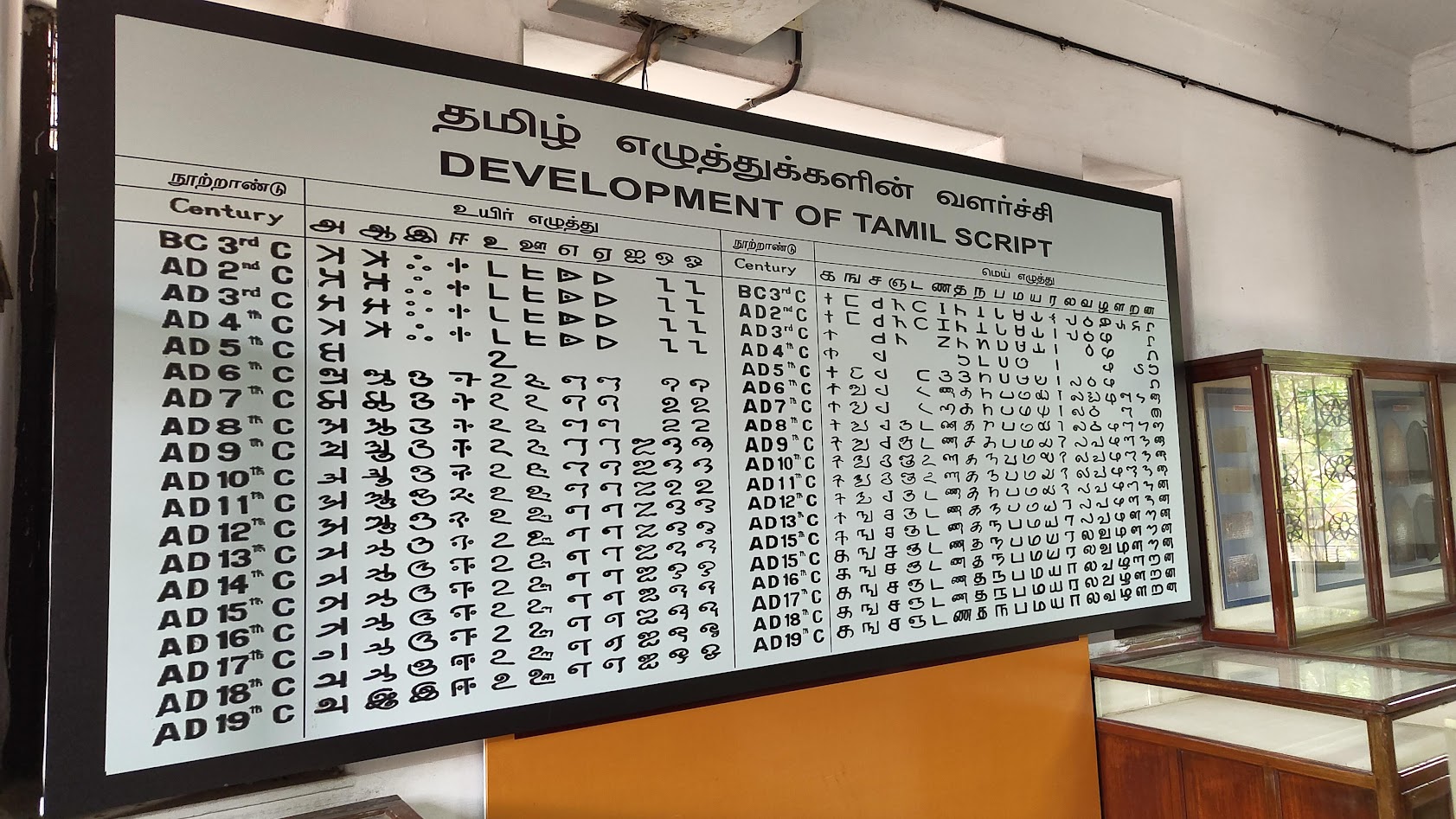
So this brought me to the question – what is the age or lifespan of a script? I saw a bunch of scripts in the museum that day and none of them exist or even resemble any modern day Indian language – and these were all from the years 800-1500 CE. Let’s try to go a bit deeper.
A global perspective on the evolution of scripts
To understand the lifespan and evolution of scripts, I decided to pick a few popular languages and scripts from modern times and dig deeper into their stories.
English
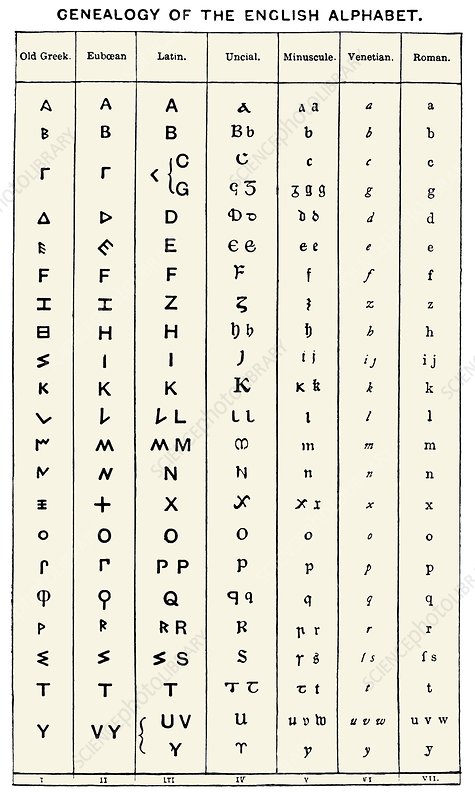
The Latin alphabet forms the foundation of the modern English script. It originated in Ancient Rome which was itself derived from the Greek alphabet. Some other interesting facts:
- Its roots can be traced back to the 7th century BC and it initially started off being only capital letters. Lowercase letters only developed during the medieval period and it was influenced by new writing tools – quills to pens and writing surfaces – papyrus to parchment.
- The invention of the printing press further standardized letterforms and propelled the adoption of the Latin alphabet across Europe and beyond.
- Religious and colonial objectives have also influenced its widespread adoption in unlikely parts of the world – for example, the modern Vietnamese script uses the Latin alphabet as its base instead of Chinese due to colonial and Catholic influence.
Devanagari
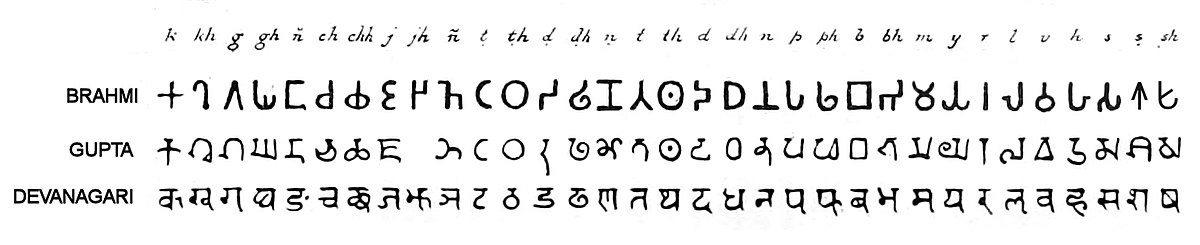
Devanagari is the script used for Sanskrit and many modern Indian languages like Hindi. It is a descendant of the Brahmi script, one of the world’s oldest writing systems. Devanagari, in its recognizable form, began developing around the 11th century AD.
However, Brahmi emerged around the 3rd century BC and gave rise to various regional scripts in India. Brahmi was one of the languages that appeared frequently in the sculptures in the museum but is no longer used in its original form. But Brahmi didn’t really “die out” – in fact, it branched out into separate scripts like Devanagari, Tamil, Telugu, Kannada, Malayalam and even Burmese, Thai and Khmer. While you may not be able to draw a straight line from Malayalam (the script of Kerala) to Khmer (the script of Cambodia) it is interesting to note that they are both descendants of the same Brahmi. The same way all humans came from Africa all those years ago.
Chinese
The Chinese script stands apart as a logographic system, where each character represents a word or a morpheme (the smallest meaningful unit of language). The earliest forms of Chinese writing date back to the Shang dynasty (c. 1600-1046 BC). Over millennia, the script evolved from pictographs (representing objects) to more stylized and abstract characters. The standardization of the script during the Qin dynasty (221-206 BC) led to a more uniform system. The Chinese script’s influence extends beyond China, impacting other East Asian writing systems like Japanese and Korean, which incorporate Chinese characters.
What Insights Do These Scripts Offer?
Comparing these diverse examples reveals some key principles of script evolution:
- Constant Change: Scripts are not static entities. They evolve over hundreds of years and are influenced by a variety of factors.
- Relative Age: While some scripts, like Chinese, boast a continuous history spanning over 3,000 years, others, like Devanagari, emerged more recently. However, even “younger” scripts often have roots in much older writing systems.
- The Technology and Medium: From stone and papyrus to paper and digital screens, the medium has a profound effect on the style and form of scripts. For example, the transition from inscriptional capitals to cursive handwriting was partly driven by the need for speed and efficiency in manuscript production.
- Political and religious influence: Institutions (e.g., monasteries in medieval Europe or imperial edicts in China) have played key roles in standardizing scripts, which in turn helped in the survival and uniformity of writing systems over vast regions and periods.
Some scripts (like Chinese) have survived thousands of years with only gradual modifications, while others have been replaced (for example, cuneiform and Egyptian hieroglyphs). The survival often hinges on cultural continuity and institutional support.
Technology’s Hand in Script’s Destiny
The rise of mobile phones and laptops has dramatically altered our relationship with writing. We’ve largely forgotten how to write with a pen, save for the occasional (and often shaky) signature. When I sit down with my 3-year-old for his writing homework, it is a revision for me as well – ensuring that those lines and curves are drawn properly!
Since we aren’t writing things by hand anymore, we are now constrained by the languages supported by on-screen keyboards. This influences which scripts thrive and which may fade away. One classic example is the representation of Hindi in English for video subtitles instead of the Devanagari script.
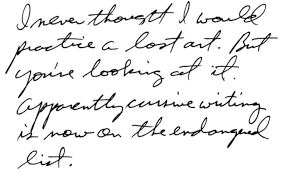
Another impact is that “cursive” handwriting is becoming a lost art. Digital communication favors “modular” alphabets easily stitched together using a keyboard.
Predicting the Future: Consolidation and Emoji Integration?
Today, emojis have become a ubiquitous part of our written communication. Their universality transcends language barriers – 😂 always means 😂, regardless of the user’s native tongue. This is a significant departure from traditional alphabetic systems.
My prediction – a further consolidation of scripts, first at a national level and then globally. Regional nuances may be lost, preserved only in museums. Could emojis eventually become an integral part of written language, seamlessly integrated into letters and documents within the next few generations?
A Glimpse into Tomorrow’s Lexicon
The future of the script is uncertain, but one thing is clear: it will continue to evolve, reflecting the changing needs and technologies of its users.
📜➡️⌨️📱➡️😂🎉🌍🤝
(Scroll/document evolving to keyboard, mobile phone, then to emojis, celebrations, and global connection)
Writing, expressing our emotions through words and sentences always take the lead. Though emojis are used universally for convenience, it lacks the sentiments and emotions is my opinion. You did a lot of work in writing this blog. Well done 👍👍 Continue writing 👏👏
Thank you for sharing! 🙂
Writing, expressing our emotions through words and sentences always take the lead. Though emojis are used universally for convenience, it lacks the sentiments and emotions is my opinion. You did a lot of work in writing this blog. Well done 👍👍 Continue writing 👏👏
Thank you for sharing! 🙂
Very interesting and thought provoking..
Thank you for sharing!
Very interesting and thought provoking..
Thank you for sharing!